Nine standing committees
Each with a named chair, a research agenda, and a fixed cadence of public work.
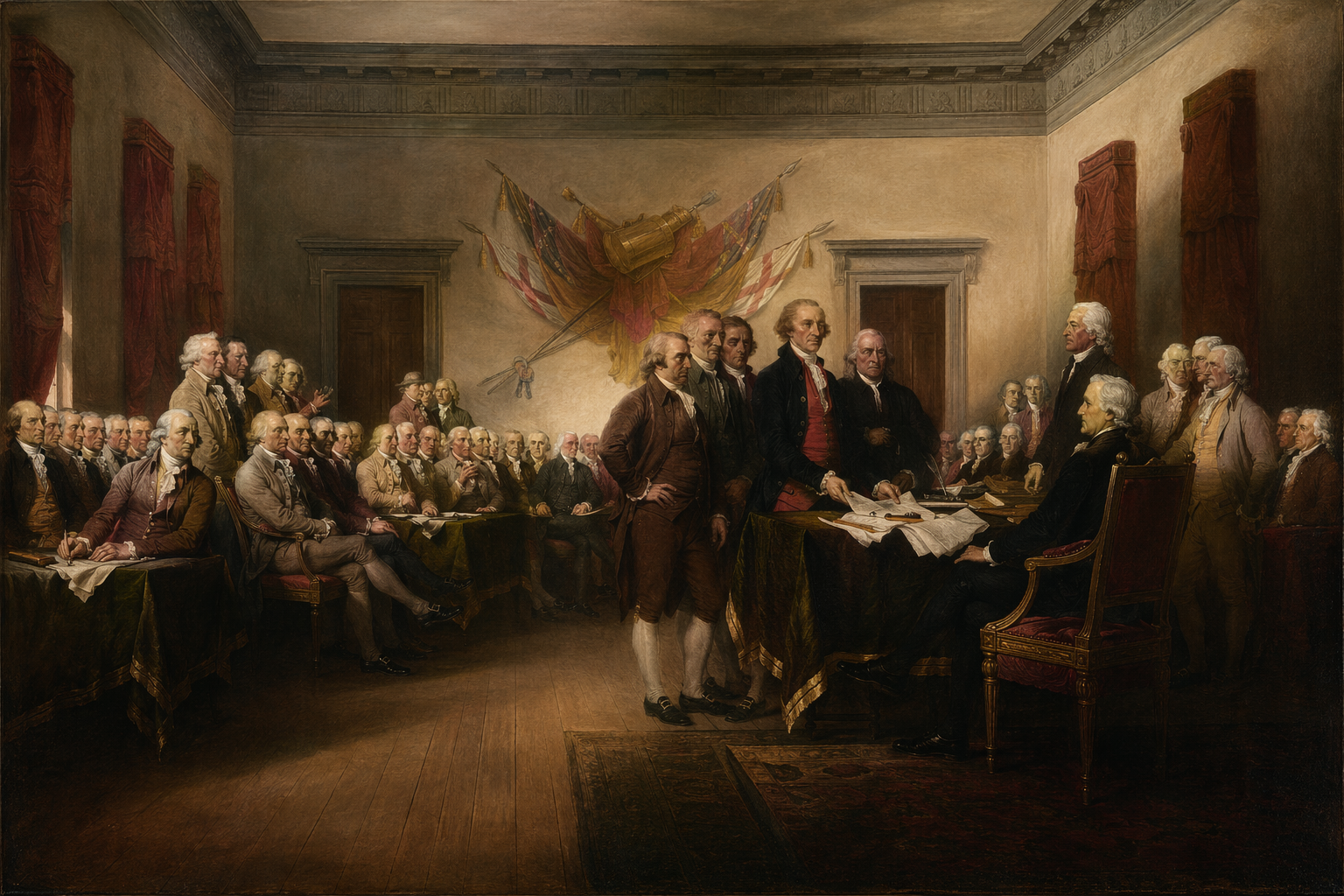
Independence was not signed because it was safe. It was signed because it was right, and because waiting any longer would have been its own kind of surrender. Every man at that table understood exactly what he risked — his fortune, his name, the rope around his neck should the cause fail. They signed anyway. A nation is not built by people who wait for certainty. It is built by those willing to act before it arrives.
Belief alone does not win a war. It was tested within months, on a frozen river, by men with every reason to turn back. They crossed anyway — and behind them followed something just as important as their courage: the forges, the powder mills, the foundries a young country built almost overnight to arm the fight it had chosen. Conviction had found its first industry. It would not be its last.
Eighty years later, the republic split itself open, and the outcome was decided by something colder than courage. It was decided by iron — plated onto hulls by hand, riveted seam by seam, until a wooden navy became something the old world had never seen. The side that could armor itself faster held the river. History does not always reward the brave. Sometimes it simply rewards whoever finishes building first.
BY 1917, THE WAR HAD REACHED BACK HOME, INTO HANDS THAT HAD NEVER DONE THIS WORK BEFORE. WOMEN STOOD AT LONG TABLES PACKING POWDER INTO SHELL CASINGS BY THE THOUSANDS — WORK THAT COULD BLIND THEM, POISON THEM, OR END THEM IN A SINGLE WRONG MOVEMENT. THEY DID IT ANYWAY, SHIFT AFTER SHIFT, BECAUSE THE MEN AT THE FRONT HAD NOTHING TO FIRE WITHOUT THEM. THE FACTORY FLOOR HAD BECOME A FRONT LINE OF ITS OWN.
Twenty years later, Detroit stopped building cars. The same assembly lines, the same machinists, the same lunch whistles — now building bombers instead, one every sixty-three minutes at a single plant. Women who had never held a rivet gun learned the trade in weeks, because the war would not wait for anyone to catch up. This was not a factory adjusted for wartime. It was proof that an entire country can become something else almost overnight, the moment it decides to.
Sixty-three minutes. That is how long it took to build a bomber at Willow Run — a number that would have been called impossible two years earlier. By 1944, the impossible had become a shift schedule. The sky was dark with what this country could produce when it decided to stop debating and start building. No one who lived through it believed it could ever be undone.
Victory has a way of making people forget what it cost. Within a generation, the men and women who built that arsenal were retiring, and the country they handed it to had already begun to assume it would maintain itself. The machine was still enormous — but no one was asking whether it was still pointed at the right problem, or whether the next generation even understood how to run it.
No law said to do it. No vote approved it. But piece by piece, we started taking it apart. We told ourselves a comfortable story: that ideas mattered more than factories, that we could keep the blueprint and let someone else do the building. We called it progress.
One shift at a time, the workers stopped showing up. The lights that once burned all night went dark, section by section. Piece by piece, we sent our own defense overseas — into hands that answer to no one here. What was left behind was an empty building, and a flag that no longer moved.
Nothing this country has ever kept, it kept by accident. Every strength we call inherited was, at some point, simply decided — by people with no guarantee it would work, and no one keeping score. That decision is being made again, by people who understood a simple fact: the cost of trying was smaller than the cost of doing nothing. Our country is not defined by what it once built. It is defined by what it is still willing to build.
One rebuilt yard becomes two. Then four. Then an entire waterfront alive again — hulls rising, cranes turning, ships sliding into open water under their own power. This is what a golden age actually looks like from the inside: not a memory, but a Tuesday. Not a monument, but a shift change. The same hands that once let this fade are now the hands bringing it back.
Two hundred fifty years after a handful of men risked everything they had to sign their names to an idea, the calling has not changed. Build. Defend. Repeat. We have done this before, in leaner times than these — and we are doing it again now. The only question left is who leads it. That is why the Atlas Institute exists.
An independent institution dedicated to American leadership at the intersection of national security, the defense industrial base, and grand strategy — a permanent, always-on presence that keeps the industrial base, its workforce, and its capital requirements in the national conversation every day of the year, not once a session.
Each with a named chair, a research agenda, and a fixed cadence of public work.
A media and analysis operation already running every day — the distribution most institutions spend a decade trying to build.
Working relationships across the operator community, the program offices, the founders, and the capital funding them.
Atlas already operates at national scale. Most institutions publish into a void and hope to be found; Atlas begins with the audience, the credibility, and the network already in place.
Daily analysis, published at national scale
A standing research agenda organized by domain, with a named chair accountable for each — work that can be cited, not just read
An audience across defense, policy, and industry
Convening authority: off-the-record working sessions that produce a durable record and a repeatable cadence
A working network inside the industrial base
Institutional continuity — relationships that outlast any single staffer, election cycle, or news cycle
Open-source method, applied every day
Independence a trade association or a single company’s government-affairs shop cannot credibly claim
Reach is the moat.
Every institution in this space trades on one of two currencies. Almost all of them only have the first.
The marquee gathering is a spike. Atlas is the signal that never goes dark — a daily open-source-intelligence operation and a readership of fifteen million that keeps the industrial base in the national-security conversation every day of the year, not four times a year.
Committee output functions as market intelligence and due-diligence infrastructure — the read on where procurement is actually going, which capabilities will exist in five years and which will not, and where the industrial base cannot yet meet the mission.
A think tank publishes opinions. Atlas is an institute of action and consequence.
Atlas is organized the way the government it engages is organized: as a set of standing committees, each owning a domain, each producing continuous work, and each anchored by a chair of national standing. Select a committee to read its mandate.
Production capacity, munitions, shipbuilding, and advanced manufacturing.
Continuous analysis published to the platform, private working sessions with operators, officials, and industry, and a domain chapter in the annual assessment timed to authorization and appropriations.
Mineral dependencies, processing, reshoring, and allied sourcing.
Continuous analysis published to the platform, private working sessions with operators, officials, and industry, and a domain chapter in the annual assessment timed to authorization and appropriations.
This chair is a founding role — the chance to define how this domain is researched, convened, and argued for over the next decade. Express interest →
Offensive and defensive cyber, electronic warfare, and infrastructure resilience.
The software supply chain, electronic-warfare capability, and the accreditation pipeline that determines how quickly new software reaches operational networks.
Software vendors, service cyber components, accreditation authorities, and the investors funding defense software.
Continuous analysis of accreditation throughput, a standing brief on software-acquisition reform, and private sessions on where authority-to-operate delays are binding.
Grid, nuclear, and the power base that makes manufacturing at scale possible.
Generation and grid interconnection, advanced nuclear, transformer and turbine supply, and the electrical capacity actually available at defense-manufacturing sites.
Utilities and grid operators, industrial developers, federal financing offices, and the manufacturers whose expansion plans depend on firm power.
Siting and capacity analysis, a standing brief on interconnection reform, and sessions pairing manufacturers with the utilities and financing bodies that gate their timelines.
Border technology, domestic resilience, and continuity of the nation.
Border and detection technology, critical-infrastructure resilience, continuity planning, and the sub-tier suppliers that serve both homeland and defense customers.
State and federal homeland agencies, infrastructure operators, detection and autonomy vendors, and the congressional offices whose districts carry the exposure.
Threat-and-capability assessments, authority mapping across agencies, and working sessions on where domestic requirements and defense supply compete.
This chair is a founding role — the chance to define how this domain is researched, convened, and argued for over the next decade. Express interest →
Irregular warfare and the operator’s view of where capability actually breaks.
Irregular-warfare requirements, rapid-acquisition pathways, and first-hand operator assessments of where fielded capability fails under real conditions.
The operator community, rapid-acquisition offices, small and non-traditional vendors, and the investors backing them — off the record.
A standing capability-gap assessment, non-attributed operator debriefs, and sessions connecting rapid-acquisition offices with vendors outside the traditional base.
This chair is a founding role — the chance to define how this domain is researched, convened, and argued for over the next decade. Express interest →
Sanctions, capital flows, and economic statecraft as instruments of security.
Sanctions regimes, export controls, investment screening, and the movement of capital as an instrument of national power.
Treasury and Commerce policy staff, export-control counsel, allied trade officials, and the funds and companies whose markets those rules define.
Regime-change analysis, addressable-market assessments under given controls, and sessions timed to comment periods and rule-making windows.
This chair is a founding role — the chance to define how this domain is researched, convened, and argued for over the next decade. Express interest →
Collection, analysis, and the open-source revolution driving modern awareness.
Collection and analytic tradecraft, and the open-source methods reshaping how governments and industry build awareness of the industrial base.
Current and former collection and analysis professionals, commercial data providers, and the policy staff who consume their product.
Methodology papers, validated open-source indicator sets, and sessions on how open-source findings should and should not inform policy.
This chair is a founding role — the chance to define how this domain is researched, convened, and argued for over the next decade. Express interest →
Allied strategy, deterrence, and the geopolitics driving demand.
Allied defense strategy, deterrence posture, co-production and offset agreements, and the geopolitical conditions generating demand.
Allied embassies and defense attachés, co-production partners, primes and suppliers pursuing allied programs, and the committees overseeing them.
Allied procurement outlooks, co-production opportunity mapping, and sessions with allied officials on where American suppliers can compete.
This chair is a founding role — the chance to define how this domain is researched, convened, and argued for over the next decade. Express interest →
Three of nine committees are anchored. Six chairs remain open — and each is an invitation to shape a domain of national consequence from the founding. A chair sets the domain’s research agenda, convenes its sessions, and carries its findings into the national conversation under the institution’s name.
Published to the platform on a standing cadence, not held for an annual report.
Operators, officials, and industry off the record and on equal footing. Atlas does not summon officials to testify; it convenes the people who move the market into working conversations.
A domain chapter in the annual assessment, plus formal work timed to authorization and appropriations.
A committee lets a member of Congress, a government-affairs office, or a company attach attention and expertise to a specific domain rather than a general mandate. An energy-focused office engages Energy & Industrial Power. A member whose district anchors a shipyard engages the Defense Industrial Base. A team representing a critical-minerals company engages Critical Minerals & Supply Chain.
Where a signal becomes intelligence, intelligence becomes a relationship, and a relationship becomes a decision.
The model mirrors the architecture of the most durable policy institutions in America: public credibility at scale, curated access for serious decision-makers, and genuine intimacy for the people who shape those decisions.
In-depth research and analysis across defense, the industrial base, and geopolitical risk, powered by Atlas News, always on. A policy brief that no one reads is not policy. These get read.
Articles · Reports · Analysis · Memos · App · Video seriesConferences, forums, and committee sessions. Not trade shows — working gatherings of defense contractors, investors, policy professionals, and senior government officials.
Conferences · Forums · Speaker series · Annual flagshipThe Atlas Roundtable. Cabinet secretaries, generals, fund principals, and defense CEOs across the table without attribution. These conversations do not get published — they get acted on.
Quarterly · Off the recordAtlas News — OSINT desk covering defense and geopolitics in real time
Original analysis and briefings that sustain the expert dialogue
The Signals Brief — proprietary industrial-base funding, growth, and readiness assessment
Committee sessions and the Atlas Roundtable
The State of the Union on National Security and the annual assessment
Where dollars meet deterrence.
How American defense spending gets allocated, what doctrine is shaping it, and where the gaps are that policy and private capital have not yet closed — autonomous systems, AI-enabled platforms, hypersonics, munitions, and supply-chain vulnerability.
Defense procurement · Pentagon strategy · Industrial baseWhere the money goes, and who controls it.
Working sessions on where capital is moving and what forces — rate environments, debt markets, regulatory shifts, and geopolitical risk — are reshaping deal flow across the defense industrial base.
Private equity · Family offices · Capital allocationThe power base behind manufacturing at scale.
Oil and gas, nuclear, grid infrastructure, and next-generation energy technology — where capital is flowing, what is being built, and how it defines American industrial capacity.
Oil & gas · Nuclear · Grid · Energy securityResearch that identifies a problem and stops has done half the job. Atlas Defense Group carries the work the rest of the way — bringing the companies building the next generation of capability, the officials who write the requirements, and the capital funding production into the same room.
Build without knowing what the government actually needs.
Writes requirements without knowing what industry can deliver.
Sits on the sidelines for want of a credible read on either.
The operator, Pentagon, and capital relationships that cannot be bought or built quickly.
Where the industrial base cannot yet meet the mission — read directly off the committees’ continuous intelligence.
The companies, technologies, and founders positioned to close those gaps, identified early and assessed on the merits.
Those companies with the program offices that set requirements, the members and staff who represent the districts involved, and the capital that funds production.
New capability fielded, new jobs created, and a credible institutional voice behind it.
A read on which companies are positioned to deliver, before they show up in a headline or a hearing.
Relationships across the Pentagon, the program offices, and the operator community, made available through a standing institute.
Already performed for banking partners, venture firms, and private equity — applied to a company before a hearing, a program before a markup, or a district before a site visit.
Senior Advisor, Energy Dominance Financing Office
Chief Executive Officer, Second Front Systems
VP, Defense Tech & Industrial Manufacturing Policy, General Catalyst
A founding board of senior figures in defense, intelligence, and finance that anchors the institution’s credibility. A founding board is formed once.
Seats by invitation for operators, industry leaders, and officials who want a hand in direction and programming while it is still being shaped.
Runs the committees, the research, and the daily platform — the team that already operates it.
Formal nonprofit structure enabling philanthropic funding, foundation grants, and institutional partnerships. Atlas Defense Group operates as a distinct arm, conducted through the appropriate entities.
Everything described here already exists. What does not yet exist is the group of people who put their name on it at the beginning.
Six chairs remain open. Set a domain’s research agenda, convene its sessions, and carry its findings into the national conversation.
Join the founding board or advisory council, connect your network to ours, or help design a flagship convening.
Underwrite the permanent infrastructure, sponsor a standing research line or named fellowship, or sponsor a flagship convening.
Request an invitation to a forum, a committee session, or the Atlas Roundtable.
We are not asking for a decision. We are asking for a conversation.
Securing the next 250 years.
Begin the conversation →For committee chairs, founding partnerships, research sponsorship, or an invitation to a session.